


Now that the Nintendo Switch is nearly a decade old, it’s easy to forget about all the games that were released during its first year. There were lots of big ones, but here are 15 smaller ones that you probably missed or forgot about.
Poi: Explorer Edition

When I first fired up Poi, I’ll be honest, I wasn’t sure what to expect. My experience with more indie-developed games didn’t come until more recently, and it was always very hit-or-miss. I either really loved the games, or couldn’t stand them. Thankfully, it didn’t take long for me to realize that Poi fit very snugly into the former category.
The game begins with you napping in a forest, when an old man approaches you and wakes you up. He’s lost a treasure of his, a medallion, and he would like one of you (you can choose to play as a boy or girl character) to retrieve it for him. You agree, retrieve the medallion, and meet the old man on his ship. Once there, he tells you that he used to be an explorer with a huge collection of these medallions, but he lost them when his ship was pummeled in a storm and he was knocked out.
He goes on to tell you there are lots of worlds out there with these medallions scattered across them, and that if you wish to become a Master Explorer, he is more than happy allowing you to use his ship on your journey. With medallions in your eyes, you head off to collect these little treasures and earn yourself the notoriety of Master Explorer by climbing, jumping, and head-bouncing your way across the worlds.
Platforming is a big drive in this game. You can jump (single, double, and triple), you can wall slide/wall jump, climb ladders and grates. There isn’t any access to any sort of combat moves, but you can squish your enemies and, at some points, kick objects in their direction. Really though, these are all the moves you need as they more than get the job done.
Right off the bat, when you begin your journey, the old man tells you about four worlds you can visit, once you’ve practiced honing your skills on the earlier worlds (aka, collect enough medallions). He shares with you his collection of explorer tools as well, since he doesn’t have a use for them anymore. These include a shovel for digging up fossils, a compass that highlights the numerous objectives in each world, a telescope to see things far away, a bigger wallet to carry lots of coins, a camera for taking photos, a magnet to make collecting coins a bit easier, and an extra heart container.
But that’s not everything Poi has to offer. If I’m being completely honest, just when you think you’ve discovered everything this game has to offer, it keeps pouring out at you. The main hub for this game is an area called The Sky, and at first it’s just you on the explorer’s ship with the four worlds to visit and conquer. That doesn’t last long, though. A handful of new characters and islands appear that offer even more challenges through mini-games, collectibles, and more worlds to visit.
On top of all that, Poi looks, sounds, and feels amazing. While the graphics might not stand up to most modern “standards”, once you take control of your character the worlds just fall into place around you. What’s more, they all look so different from each other. From forests, to sands, a volcano, slippery snow worlds, using everything at its disposal to t’s fullest extent.
There wasn’t a moment in this game, either, where the controls didn’t feel anything but smooth. When you’re grabbing the first medallion after being woken up in the forest, the game introduces you to the controls in a quick fashion that is as necessary as it needs to be. As a gamer, I’ve played far too many games that over-explain the simplest of concepts, but Poi trusts you with that pretty little head on your shoulders.
Lastly, the music is just perfect. It suits the themes of adventure and exploration, and meshes beautifully with everything around you. It seems to quiet down just the tiniest little bit when you’re caught up in some action, then kicks back into full gear when there’s not a lot going on around you.
Poi is a great play from start to finish, and just beating the story won’t be enough. Once you discover not even half of what this game has to offer, you’ll want to do everything you possibly can. And if indie games aren’t really your thing, let me just ask : does anything I mentioned above sound familiar? Traveling to different worlds collecting medallions, the triple jump, wall sliding/jumping…
Poi is an excellent example of an indie inspired 3D Mario game. Before you even collect the first medallion, you’ll feel like you already know this game, and to me that’s what makes Poi a must play game. It takes the core concepts of something that’s familiar to all of us as gamers (Nintendo gamers specifically) and gives it new life.
8/10
Revenant Saga

KEMCO has been around since the early days of the NES, and for the last couple of years, we’ve mainly associated them with streamlined, 16 bit style RPGs. Now, they’re offering up Revenant Saga for Nintendo Switch as their standard-bearer.
This was a wise choice. Of the half dozen role playing games that I’ve played from KEMCO, this entry has the earliest “gotcha” moment yet, and that is a very important factor to have in a nostalgiac style of role playing game. What is a “gotcha” moment? It’s the precise moment at which the game plants it’s hooks firmly inside your brain and refuses to let go.
We start off with a fairly standard trope- an antagonist orphaned by the deadly war/disease that has been spreading amongst the villages and leaving destruction in it’s wake. In this case, we have a deadly plague. One that is so virulent, that those whom came in contact with the afflicted are asked to leave in hopes of preserving the town.
Our hero’s (Albert) best friend/possible love interest’s (Anna) parents are afflicted with this plague, and while they are being tended to, a mysterious stranger walks into town to assess the situation. He tells Albert that he may have a solution, but that he will have to come talk to the doctor alone, in the Inn.
After talking to Anna, Albert leaves and goes to discuss this cure with the doctor. He is told that the doctor is working on a cure, and that he needs human volunteers to test the drug on. Those test subjects are not to tell anyone. Albert reluctantly agrees in an attempt to save Anna, and so departs for the doctor’s lab. Albert shows up, and is escorted to a room that he is locked into, and he becomes concerned.
After Albert is in the test chamber, it is revealed that this was a trick, and that the doctor is going to be turning Albert and the others into revenants- a type of demon.
The doctor is interrupted by what is essentially a paladin sent by the religious order in the game. The ensuing conflict results in Albert being only half transformed, and the paladin missing(or dead?), and Albert discussing his current fate with the demon inside himself.
Albert can now transform to utilize the power of the demon, and he vows to use his powers for good, instead of evil, until he can claim vengeance upon the doctor that did this to him, and possibly killed his friend, Anna.
Fast forward two years, and we find ourselves in a world with increased patrols from the religious order, and a need to find an inn to help satiate the hunger of the demon (Magnus) within our protagonist. While at the inn Albert will use to calm down his literal inner demon, he encounters a revenant, and is soon joined in battle by a Valkyrie in training. From there, we begin our main quest to avenge Anna and Albert’s loss of self.
This is, for all accounts, very standard RPG fare. It borrows elements from various series throughout the years, and puts it’s own spin on them. This game is not genre defining, but the story and characters are gripping, even if delivered in more cliches than we would like at times. It has a very streamlined and familiar structure- go to town for story beat, halfway there you pause for a rest, which allows for some more character development. Then, we arrive at the dungeon, fight our way through it while navigating labyrinthine treasure cubbies, and then occasionally running into a boss and more story. Walk back to the last village to report to the religious order, then find out where the next dungeon will be, and repeat.
Thankfully, the characters are interesting, and the story is solid enough. The best part of the characters is how they spend so long keeping secrets from each other, and performing sitcom like levels of backtracking to try to justify their lying existence.
Advantages to this game that older RPGs do not have are the ability to save anywhere in the game, a streamlined customization system, an L shoulder button away from rereading the last little bit of conversation if you accidentally skipped it (or did so on purpose to read it all more quickly to move on), and two different auto battle features. I’m not sure what exactly the semi auto fight feature does, but if you press “X” at the beginning of a fight, your characters will all just attack using normal commands. This last bit is the best way to deal with most of your random encounters.
Even the bosses are somewhat easy, but that’s okay, because we’re not exactly playing this game just for the strategy of combat.
There is, however, a lot that can be done with combat, if you so choose. Most of that revolves around transforming your characters and then utilizing their special skills to give you the upper hand. The drawback to transforming is that you can’t heal, and if your character dies, you have to wait for the end of the battle to be revived.
There are plenty of collectibles to be found, many of which can be used in customizing your weapons by adding attack power, status effects, skills, or stat boosts. There is even a pseudo achievement system that allows you to receive rewards from “record keepers” located around the world, each of whom will give you a prize every time you reach specific milestones.
There is also a modified version of a micro transaction system from the mobile version of the game where you can earn a special kind of currency that allows you to buy “cheater” items like high powered HP restoratives and items that increase party stats like luck and drop rate of rare items. Instead of buying the points with real money, you earn those points by defeating enemies.
Overall, the game is a solid entry in the RPG pantheon, and it felt like exactly what I needed for my Switch. While I didn’t really ever need to grind to progress through the game, as you will be well paced by just exploring your dungeons for treasure, I did find myself doing it out of habit every so often, just because I could mindlessly cut through a horde of monsters with my overly powerful sword, a certain accessory that you get early on, and the X button to auto fight. This isn’t the epic tale to dethrone the classics, but it is a really good homage to them.
6/10
Ittle Dew 2+
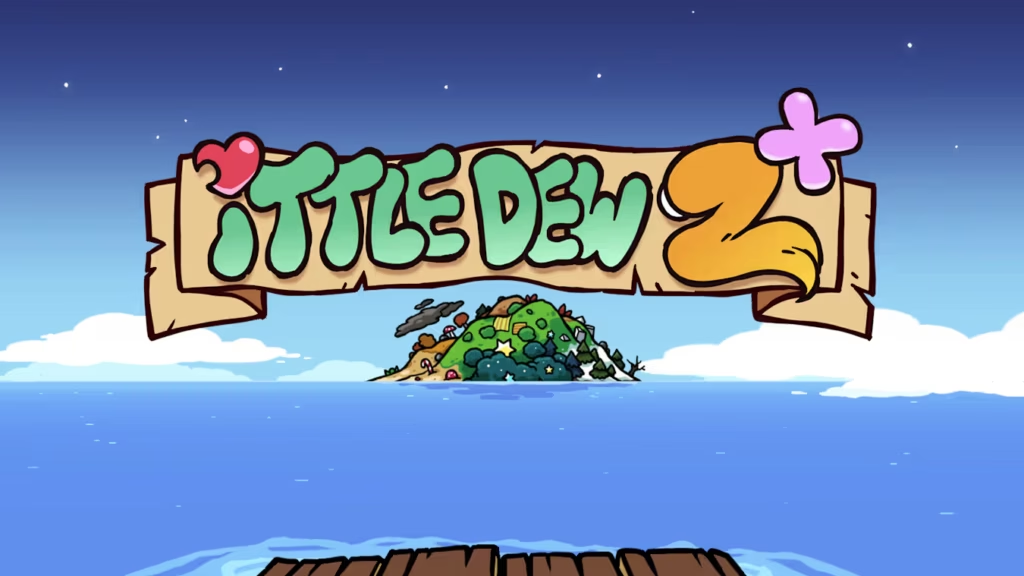
I didn’t know much what to expect when I launched Ittle Dew 2 on my Switch. Would this be just a weird game? The graphics and concept intrigued me, but how well would the game play?
The answer is yes, this is a weird game. Weirdly wonderful. It reminds me of a lot of the Zelda games; monsters all over the place that you need to whack, breaking pots to find goodies, dungeons with puzzles to solve. Most of all, I fell in love with the humor in this game. The developers really took time to create a polished game that hooked me from the start. I tend to lean on humor, and this game spoke to my inner funny spirit animal. Cartoony and fun, not only did they anticipate our need for humor and a great story, but the graphics are also crisp. I didn’t experience any lag, either.
We find our heroes, Ittle and her assistant Tippsie on a raft which inevitably crashes in to an island and is destroyed. Now, all they can do is explore the island for the 8 pieces, located in various dungeons, that will fix their raft. Ittle Dew 2+ definitely follows your typical Legend of Zelda formula; you can talk to everyone on the island to get advice and you can even get a “thank you” from a resident for cleaning up…by destroying everything in their house (what fun!). The world is decently sized, and you will have to unlock areas of the map to find more dungeons and boss battles. Some dungeons can only be unlocked by finding characters in mysterious dungeons who will unlock special dungeons for you.
There is a great emphasis on solving puzzles, both inside and outside of dungeons. You will have to push, whack, light things on fire, play a tune, or run around a tree to solve these puzzles. Having such variety in puzzle solving kept the game fresh and intriguing. There are plenty of brain teasers surrounding hidden chests that will keep you on your toes; these brain teasers will give you access to more health or ability to buy more items. Unlike most Zelda games, Ittle Dew 2+ is an open world. You can explore the entire map if you want to and even try out dungeons you may not be entirely ready for. The humorous banter in the game definitely helps keep things fresh, especially when much of the in-game battle is fairly repetitive. You will spend a significant amount of time in the beginning with a short-range sword but will unlock things such as fireballs later in the game. This will be important because as you progress to more difficult dungeons, you will encounter more and more enemies coming at you at once.
There are 8 dungeons that you will explore, but there are a fair amount of mini dungeons that you will go in to to acquire information or items. Much of the puzzle solving revolves around block pushing, but this isn’t all of it. There is plenty of combat to have with simple to difficult enemies. Your first encounters will be with people who have foam swords and have pillows tied to their torso’s. I had to stop for a moment and take in the memories of me as a child, play fighting with my brother.
Anyways, Tippsie can come in very handy throughout the game. He can give you some pretty good advice on how to solve the puzzles and whether or not you are adequately equipped to solve the dungeons.
Looking at the graphics and music, this game is phenomenal. I had looked at screenshots from the original Ittle Dew, and it is clear that the developers took time to really give Ittle Dew 2+ a make over to make the game look much better. Shading and gradients really give this game a sense of life and completeness. The music is upbeat and quirky and I found myself really enjoying just listening to it; it is really well matched to the game and is quite catchy. There wasn’t a song throughout the game that I found annoying…quite the opposite…I would listen to this music right now while I work if I could.
Offering something for nearly every taste, Ittle Dew 2+ contains a carefully curated balance of weapons-based combat, deep exploration, intense boss battles, charming storytelling, brain-teasing puzzles and treasure hunting. The expansive island environment holds more secrets than most players will ever be able to discover, with a series of challenging dungeons that can be explored in any order.
“If you’re looking for a colorful, long-lasting adventure with memorable characters and endless surprises, then Ittle Dew 2+ is the perfect game for you,” says Nicalis founder and president Tyrone Rodriguez. “And if you go for the Game Card version at retail, you’ll get some really cool bonuses, like a tear resistant island map and an adorable instruction manual.”
He’s right, the game is colorful and memorable. It is an excellent addition to my Nintendo Switch library, and a game I will keep coming back to.
8/10
Morphite

So, you want to go on a great space adventure. At first glance, Morphite may not look like it can deliver that, but don’t judge it too quickly. The 3D Polygon graphics will instantly bring you back to Starfox, while the depth that this game offers brings you what No Man’s Skypromised.
Our story begins with Myrah being sent off on a mission to a nearby planet within her system. She goes scavenging some minerals and scanning some of the wildlife and fauna before returning to report her findings and being sent off to yet another planet to do even more scavenging. It is on this second planet where Myrah comes up close to the titular rare mineral, Morphite. A mysterious orb that is trapped within a glass container.
That is until Myrah breaks it out and it begins following her. She continues on until she comes across a throne nestled on a small hill. The Morphite ascends to the throne and instantly transforms into ion grenades in from of Myrah’s eyes. As the transformation happens, a group of what appear to be soldiers land on the planet and chase after Myrah. Once again, she returns home to report her findings and is immediately pulled off the rest of the mission due to her strange interaction with the Morphite. Instead of listening, she packs up and heads out, taking the mission on by herself.
With the galaxy spread out before you, filled with procedural-generated planets each with its own distinct animal and plant life, you get to uncover the story of Myrah and her strange connection to the rare mineral. Along with your main mission, each system and its planets are loaded with side missions for you to take on as well.
You get use of Myrah’s ship to travel between systems. The fuel in the game regenerates slowly over time and, unless you upgrade, you’ll only have enough fuel to hop one planet at a time. You can land, spend some time on the surface looking for any available missions and, by the time you return to your ship, you’ll have enough to make the next jump.
Scanning things is your biggest way to make money. With every planet having its own specific plant and animal life, people elsewhere in the galaxy will pay money for these scans, just to know what else is out there. You can also make money off the minerals you collect, but for the most part you’ll want to hold on to these as they are crucial for upgrades to your ship and Myrah’s suit. Myrah’s suit upgrades can be done on just about any of the planets and you can upgrade things like your resistance to severely hot and cold temperatures. This gives you access to even more planets to land on.
One thing I really enjoyed about this game were the random asteroid fields that you have to navigate through. After you choose a planet to land on, you will receive a warning about an incoming asteroid field and then be switched to an out-of-ship perspective to navigate the deadly rocks.
Graphically, this game won’t stand out to impress. It’s built off of 3D Polygons, giving everything a very blocky look. I say this simply to make note of it because even built like this, the game and all it’s planets still look really good. They even manage to give all the humanoid characters (at least the ones not wearing helmets) little noses. It’s such a tiny detail but it helps give everything a little bit more depth and character.
While I wasn’t blown away by Morphite, I wasn’t put off by it either. The vast universe does seem to go on forever and the story does its best to pull you to all corners of all the worlds. So whether you want to follow Myrah’s adventure or take off on your own, Morphite promises plenty of hours to do so. It’s worth noting that every person’s experience with this game may vary from playthrough to playthrough. The procedural generation makes for a good variation, so someone playing the game themselves may not come across the same things I did while playing, or not in the same manner either.
6/10
Stick It To The Man

What would you do if one day, you had a gigantic pink spaghetti-arm sticking out of your head? What if this arm was only visible to you and nobody else, and it granted you the power to read other people’s minds and change the world around you with stickers? Well, that’s what happened to Ray.
After finishing a shift as a hard-hat tester, Ray is walking home from work when an object plummets from the sky and conks him on the head (maybe if he had brought his work home with him…). He falls into a coma-like state where, in this dreamworld, there is a pink arm sticking out of his head. This arm grants him the few powers mentioned above, as well as the ability to grab onto red pushpins in the world and swing to higher and hard-to-reach places.
When he wakes up, he’s being thrown out of a hospital because his insurance doesn’t cover head injuries (go figure). On his walk home from the hospital he learns two things. The spaghetti-arm is real, and a bunch of nasty guys in suits are chasing after him for a crime he’s unaware of committing. After he returns home, his girlfriend reveals that she can’t see the supposed arm sticking out of his head, and tells him to seek psychiatric help for sounding crazy.
Stick it to the Man is a puzzle and platforming game, and it’s presented as a 2D paper themed world that is equal parts wacky and beautiful. Certain points the levels will be “loose”, able to be torn away with “the hand” to reveal things that will help you progress.
Your main way of progressing is by completing puzzles that require you to read people’s minds to discover what they need, and then find the respective sticker to help them. Most levels will have a sort of domino feature, where you will only find one or two stickers freely in the level, and the rest will be rewards from solving those puzzles and bringing the new stickers where they need to be.
Combat is virtually non-existant in Stick it to the Man. A few levels in, after you’re introduced to the goons chasing you down, you learn a mechanic where you can sneak up on these guys and read their thoughts, typically about eating a lot of food recently and being extremely tired. This will produce a sleepy sticker which you can then slap on one of the goons and put him to sleep allowing you to sneak by unharmed. Otherwise, if Ray takes a single hit he’s done for and sent back to the most recent printer you walked past.
Speaking of which, the respawns are one of my favorite features of this game. It’s a quirky way of sticking to the paper-world theme and honestly, after I saw it the first time, I might have intentionally walked off the level a couple of extra times just to see it again.
Everything about this game is equal parts wacky and beautiful. The humor is on point, even a little dark at times, but when you factor in that Ryan North from Adventure Time wrote the story, it just fits. The platforming might be on the simpler side, but puzzles are easily the high point of this game in my opinion, and are a ton of fun. Stick it to the Man will be a great addition to your Switch library, so don’t hesitate to snag this one from the eShop.
8/10
This Is The Police

There tend to be a lot of games on the market involving the police, whether playing as them or trying to escape/avoid them. There’s also plenty of strategy games on the market as well. However, This is the Police is one of only a few games (that I am aware of) that combines both of these things.
THQ Nordic’s game places you in the shoes of police chief Jack Boyd, who runs the precinct in the games city of Freeburg. At the start of the game, the city’s corrupt mayor is forcing Jack into early retirement six months down the road. Before he retires, he is given the task of earning half a million dollars while running his department and fighting crime in the city.
The player is given two shifts of officers that must be balanced, and properly sent out to respond to calls so that all criminals are caught and no lives are lost. There are a number of crimes that will occur, some more severe than others. The more severe the crime is, the more officers it will take to insure that everything goes swimmingly.
In addition to responding to these calls, you’ll have to deal with shift management, hiring and firing of cops, potential loss of life on calls, and even dealing with the Mafia later on in the game, who will step in and ask you to look the other way on certain phone calls with the promise of a big payoff for you. Or they’ll just threaten to kill you if you don’t listen to them.
Most of This is the Police takes place on an isometric map of the entire city. Calls will pop up on the map, and once you answer them you’ll be given a number of slots for how many officers you’re allowed to send out. Most calls will take just two or three, but some calls may require more of your shift or, if it’s dangerous enough, you’ll have the option to send in a SWAT team. You’ll even receive calls from places in the city asking for a favor : if you can send a cop to act as a bouncer for a night club, or to participate in a boxing/fighting contest. However, these calls run the risk of the officer really enjoying the event/job and wanting to quit the force for it.
You’ll be given what feels like every duty of a person leading a police unit. Everyone’s happiness is important, but you also need to keep yourself well-staffed for a shift, so finding the balance between being the boss and the nice-guy is definitely important in this game, as officers will request a day off of work and you need to determine if it’s for a legitimate reason or something ridiculous. You can always give them a day off and bring someone else in for overtime, but this leaves them tired and runs the risk of a criminal getting away or the officer dying on duty.
I’ve had a lot of fun with this game, and especially on the Switch. If you play This is the Police in handheld mode, you can make use of the console’s touch screen which greatly speeds up the process of responding to calls and selecting officers to send out, or responding to requests.
The story is incredibly well done, and by far one of the top highlights of this game. Between each day, a small cutscene may take place to fill you in on things currently happening, and while the animation is very simple, the voice acting really drives home a lot of the intensity needed from the subject matter, doing a great job of pulling the player in.
However, as great as this game is, the gameplay may end up being a bit slow and repetitive for a lot of players, as it is a lot of the same over and over for the duration of the 180 in-game days. This might not be a title to grab if you’re not a fan of strategy games, but at the same time the intense story could definitely help make this a great introduction to strategy games. Nevertheless, This is the Police is a lot fun, and again I highly recommend playing this making use of the Switch’s touchscreen.
6/10
Astro Duel Deluxe
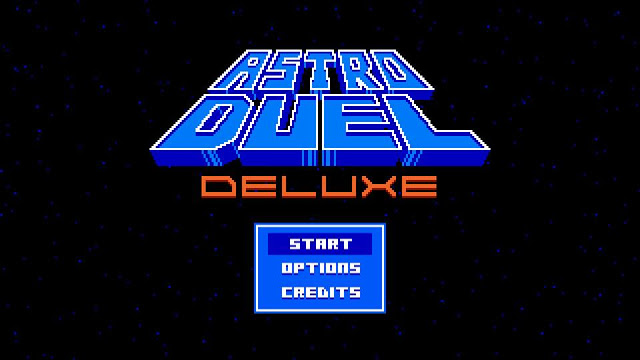
Sometimes, a game doesn’t actually need to be big, to have the feeling like it is. Astro Duel Deluxe certainly is a title that fits that description. It’s a multiplayer (or solo vs computers) top-down spaceship combat game,pitting all the pilots in one of a dozen arenas against each other.
There are three different game modes featured in Astro Duel, Classic, Party and Chaos. All three revolve around the same basic mechanics, with minor tweaks applied to each mode, so let’s cover the main gameplay first and then I’ll discuss the differences.
In each round, you need a minimum of two pilots, and can have up to four or six depending on which mode you play (any combination of human and CPU). The pilots zip around the levels, shooting at each other with the basic gun that comes with each ship, or firing off the special weapons that can be picked up in each level. The last ship left standing is the winner. Rinse and repeat until one pilot has enough victories to win the whole tournament.
The length of the tournament is determined before you enter the first round, and you can make it short, normal, or long by setting the number of kills that must be achieved before victory is claimed. You can also decide if you just want to destroy ships, or if you want to kill the pilots themselves. If you decide on pilot kills, once the ship is destroyed, the pilots float around and can still be “driven” around the level. If you can survive like this for a short amount of time, your ship will respawn and you can continue on in the round.
There’s a handful of different powerup weapons you can pickup in the levels, including a scatter shot, reflector, shield, jouster (which allows you to just drive into opponents), missiles and proximity mines. These are all single use weapons, and in the case of the shield it protects you for one extra shot, and the reflector also protects you from one shot that you take to the front and sends it back.
All of this is consistent no matter which of the three modes you choose to play Astro Duel Deluxe on. In Classic mode, the rounds feature between two and four pilots, while Chaos mode mus be five or six pilots. The biggest different is in Party mode. This is played with the Switch flat down on a tabletop, it uses the touch screen of the console, and instead of you getting free flight controls, you can only turn to the right by tapping and holding on the screen in your respective corner.
This game is a lot of fun, and extremely hard to put down. The only thing missing is online support, but multiplayer is supported no matter what way you’re playing this game.
8/10
Ben 10
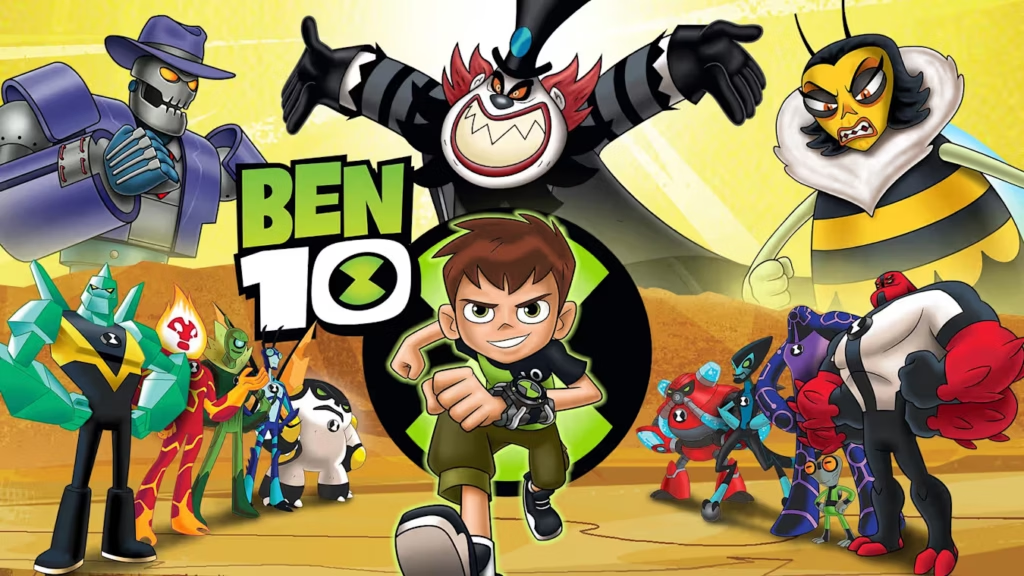
I’ll be the first to admit, I’m not generally a fan of a game based off a TV show or Movie; most of the time they seem like just a little extra effort to bleed a few extra bucks from the fan base. They seem quickly and poorly made and don’t really add anything to the franchise. I was a little wary of this possibility when I loaded up Ben 10, afraid that it would be a regurgitated formula of poorly made “fan” game. I was pleasantly surprised to see that this wasn’t the case. Outright Games seemed to really put the time in to Ben 10 to make it a fun game, whether or not you are a fan of the show.
I suppose that a big factor in to helping spur the fun of this game is that Ben 10 is the type of show that almost feels like a video game to begin with. Featured on Cartoon Network, Ben 10 features a boy named Ben Tennyson who discovers an alien wristband (Omnitrix) which gives him the ability to change in to different alien, each with different powers. He uses each different alien to help out with situations and crisis’ as they arise, depending on which ability he needs.
In the Nintendo Switch Ben 10 game, we find our hero running around the 3D beat-em-up world on city streets, forests, and junkyards. Zombozo is on the loose, and he is taking people’s happiness on the day of a parade! (how dare he!). To change in to your alien form, you use LZ to pull up a wheel with all of the aliens that you can change in to. From the beginning you only have 3 aliens to choose from: Four Arms, Cannonball, and Heatblast. These three are ample in abilities to help you start chasing down Zombozo and his cronies. Clowns and Jack-in-the-box’s will periodically appear and you will have to beat them down before they beat you. Pressing Y will do your average attack, punch or throw small flame balls. As you use more combo’s, your alien boost points will fill and you can use ultimate moves to pound the enemy in to oblivion. X is also handy, as it knocks back your enemies.
As you run through the streets, destroy everything; boxes, trash bins, light poles, etc. Doing so will release green orbs which you will need to collect to power up your alien’s further in preparation for your impending boss battles. Collect enough green orbs and unlock different perks for your aliens such as higher attack power. The enemies, however, don’t seem too difficult to beat and it definitely feels as though the point of the game is really to unlock all the aliens and unlock all the perks.
The biggest plus to the game is that the story really keeps you engaged. From the beginning cut scene to missions and story-updates, you will keep playing to see what comes next. The game does present a lot of diversity. You can’t get away with using one alien for the whole game; certain parts of the game will require the specific ability of specific aliens (like four arms to rip off a gate, for instance). It forces you to continuously switch what you’re doing and helps fight what would otherwise become quite monotonous. There are 6 stages in the game, and each stage feels like an episode from the show; something that kept me engaged throughout the whole game.
There was a major plus to the game that I realized after my 4 year old son nabbed my switch; Ben 10 is a kids show and my 4 year old was able to figure out how to play the game (with a little help from dear-old-Mama). It kept him engaged for over an hour, which for anyone with a young child knows…that is quite an accomplishment. The game was diverse enough to keep even me entertained, but simple enough that my preschooler was able to play through the game. Since there are few games on the switch that are simple enough for the younger demographic, this was a great addition to my library.
8/10
Red Game Without A Great Name

Before there was Green Game, there was Red Game Without a Great Name. Don’t let the name fool you, because what’s inside truly is a great game.
Still set in a steampunk world, and still navigating for a lonesome bird, your task in this one is to successfully deliver letters across the games 60 different levels. This time, you’ll be teleporting the bird around objects instead of manipulating time to turn steam machines on and off. You’ll start off in a cage, and must safely reach a cage at the other end to complete the level.
Once again, you are able to collect three gears in each level before you complete it. These are still purely optional, but doing so will highly increase the challenge of each level.
Teleporting the bird around objects is fairly simple : just tap your finger on the bird and slide across the screen. This will bring up a dotted line, and wherever you lift your finger up is where the bird will appear. As “navigation” alone, it seems like it would be a lot easier than Green Game’s time manipulation, but in fact it is just as challenging. The levels will have numerous places with extremely narrow gaps, and you’ll have to be fast with teleporting the bird once again just as soon as it appears.
I absolutely love this game, and can’t get enough of it. Again, ifun4all has done a great job with such a simple concept. As of right now, Red Game Without a Great Name is only available in the Europe eShop, but in just a couple weeks it will be available in North America as well. When it drops, I highly recommend picking this game up as well as it’s sequel. With such low price tags as $2.99, you can grab both these games for under $10 and have hours and hours of brain twisting fun.
7/10
Sparkle 2
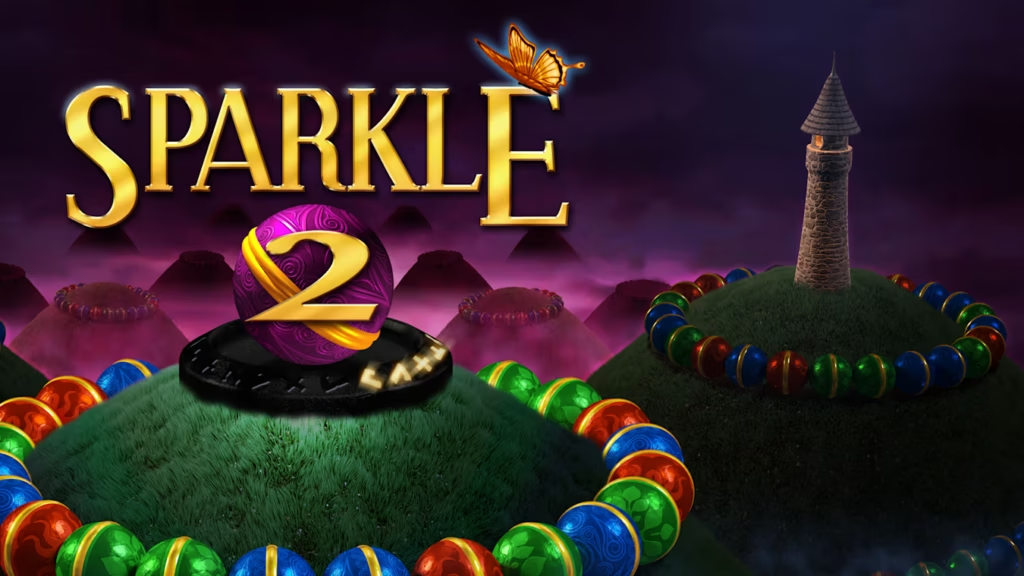
Sparkle 2 is a marble shooting, match three puzzle game brought to us by 10Tons. As is the company’s modus operandi, they’ve taken what could have been a simple clone of a wildly popular game and made it their own. Any fan of video games, from the most casual grandma clicking away on her windows XP machine to the most hardcore multisystem gamer will recognize the Zuma influence from the screenshots. However, the mere appearance and entrance in to the same subgenre of puzzle game is where the similarities end.
Sparkle 2 is it’s own magnificent beast in many ways, and much of that has to do with what 10Tons has done to improve upon the basic premise of the subgenre itself. Present is the addictive game play, bright colors, beautiful environments, and soothing but wonderfully complex music (although that does get repetitive because there aren’t enough tracks in the playlist), but added on are a bunch of little fine tuned features that enhance the experience over all.
As you play through the story mode, you unlock additional modes every couple of stages (called days, here). In addition, you unlock keys to allow entry past barriers that block your progress, and you earn experience points to upgrade your marble shooter with such enhancements as fast shooting, slowed down levels that make it easier to plan out your next chain, but make the game take longer, and one that adds another orb to your marble shooter. You can swap between the orbs displayed to best utilize which color you need to complete a chain of colored orbs.
On top of all of this, there are also one time use powerup orbs that send out a ring of fire, blast out a ray of frost that destroys anything in its path, moves the orbs backwards, or changes all of the orbs it hits in a section to the same color. The game is fast paced, and the difficulty level increases quickly even on normal mode. There is also an appropriately named “nightmare difficulty” for maximum challenge. Along the way, as mentioned above, you can unlock challenge mode and survival mode. These add even more hours to the game play, making it a great value on top of the 8-10 hour quest mode.
The game boasts both docked and undocked play, but handheld mode is preferred because of the touchscreen controls, especially for the younger crowd. All-in-all, this is one of the best puzzle entries available for the Switch, and Sparkle 2 will not disappoint the puzzle crowd. The challenge and role playing elements bring setting to the table for everyone else.
7/10
Mom Hid My Game!

I was once a young gamer, hiding my game boy under the covers with a flashlight after bed time so that I could get just a little more gaming time in. Sometimes, I got caught by my parents and was grounded from my game boy for a few days. I think this is a struggle that most gamers have experienced at one point or another in their lives.
And this is where Mom Hid my Game! pulls on the heart strings of traumatic memories of losing access to our precious video games.
When I first heard of the concept of a game themed around having your video game hidden from you, I was definitely intrigued. Upon seeing the graphics, I couldn’t say that I was horribly impressed, but the intrigue for how this game would play out still remained, so I pursued playing it to see what KEMCO had offered us.
The game begins like a childhood memory. This little Japanese boy is sitting on the ground playing his game and minding his own business (but probably neglecting to do chores and homework). Mom comes in, clearly pissed off, and nabs the game from little J here and hides it. J freaks out and starts looking everywhere for his game and finally screams out “My Game is Lost!”.
This is where our game begins. Clearly, little J here is your average gamer whom gets it taken away on a daily basis for neglecting to do whatever it is he is supposed to do. The dialogue is in Japanese, so I can only go based on what I’m sure is happening…based on my own memories.
Each level is referred to as “days”, thus assuming that little J here gets in trouble every single day. Instead of putting the time in to doing whatever it is his mother is upset about him neglecting, he does the obvious thing…the thing we would all do in his situation…go search for your game so you can keep playing.
But watch out, don’t get caught by mom or else you lose!
Mom Hid My Game! is your typical Japanese humor which is always enjoyable. I have to be honest, while I was intrigued by the concept, just based on the graphics I didn’t think I would enjoy it too much. However, once I sat down and got in to it, I found that I enjoyed it a lot more than I originally thought.
The game starts off simple enough, find the game…avoid mom. It doesn’t stay simple for long, through. Mom will be hiding in unexpected places and you will have to figure out how to use items to get to your game. For instance, making someone go pee because for some reason they are camped out on top of your game. Items are crucial in this game. Don’t rush it, sit and think about how best to use your items to get your game back.
While the graphics may be very simplistic, the game is quite complex. The music is what I would expect from a puzzle game; nothing too exciting but the perfect background music. I don’t see myself sitting down and playing this game for hours, but it is a casual game that I enjoy playing while I am bored or when I cannot dedicate myself to bigger games that suck you in completely. So parents, this is a perfect game for you. Mom Hid My Game! is a game I could easily see being a mobile game, and as such it is a great game to have with me while I wait in line at the DMV.
6/10
Spellspire

Spellspire brings whole new meaning to the phrase “Knowledge is power”, because in this game, it’s essentially your only form of attack. There’s 100 levels in the Spellspire, the titular in-game tower where everything will take place, and you must reach the top.
Each level begins with your mage auto-walking towards the right of the screen. Enemies will be spawned placed out in front of you, and you will have a pile of ten letter-tiles randomized on the screen. Each time you successfully spell a word, an attack will be sent out at the closest enemy in front of you, and the strength of the attack is determined by the length of the word you’ve spelled.
Once you’re close enough to an enemy, a red-filled circle will appear on the screen and instantly start depleting. This represents how often your enemies attack and if you can take them down before the circle is empty, they won’t attack at all.
The one gripe about Spellspire is obviously the fact that the gameplay itself can begin to fill quite repetitive. Start a level, spell some words, go to the next level, rinse and repeat 100 times. However, its the inclusion of an RPG-type element that saves the gameplay from feeling too stale.
Along your journey, you earn coins which can be spent on any number of items including mage staffs which deal elemental damage, robes which can boost your health and give you protection from elements, and hats which will give you stat boosts such as three-letter words dealing double damage. Most of these weapons are unlocked by reaching a certain level of the tower, while other’s require you to obtain a certain number of stars, which those are earned by replaying levels that you’ve already beaten.
Finally, there’s items you can pick up along the way as well. Potions for healing yourself, and little dictionary’s. These are the greatest asset for if you feel trapped and helpless. Using the dictionary will automatically find the longest word possible with your available tiles, sending out the maximum attack possible, so it’s definitely worth holding on to until you find yourself in an endless cycle of getting killed.
While it might not be the most action-packed game, Spellspire is a fun and interesting play. The blend of vocabulary-puzzle and RPG-elements definitely make this a game worth checking out. It’s more of a simple game, but it has potential to sink it’s hooks into you as well. It’s worth noting too, that this game can be played docked on the TV, handheld, or in tabletop mode, but the best way to play this game will be handheld and making use of the touchscreen. Being able to tap out the words you want to spell instead of moving a cursor around with the joysticks will speed things up immensely.
7/10
The End Is Nigh
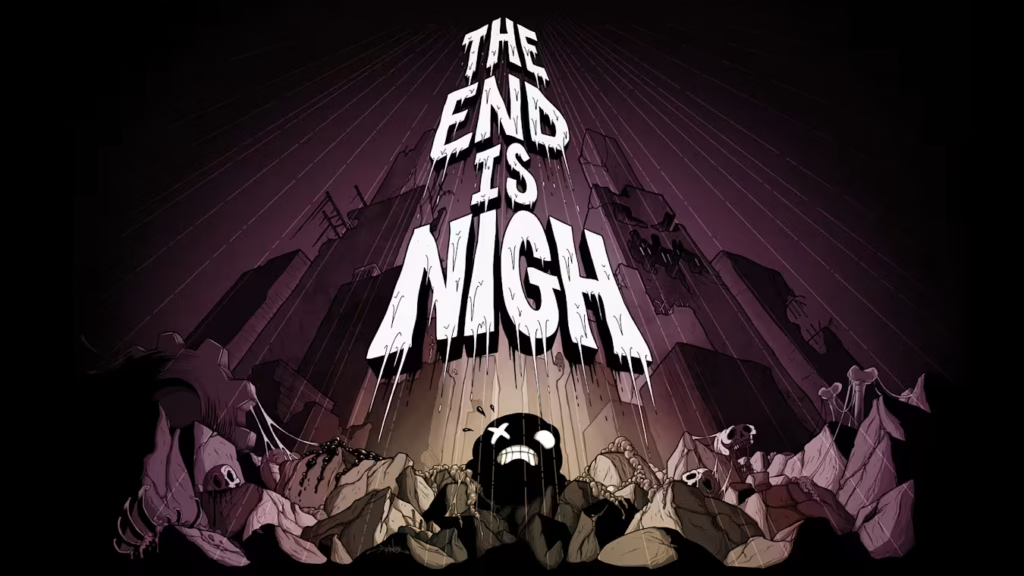
The End is Nigh is the latest game from the co-conspirators of Team Meat, Edmund McMillen and Tyler Glaiel. The due first brought us Super Meat Boy in the wake of the explosion of indie titles on home consoles that began nearly a decade ago. Super Meat Boy was a testament of precise platforming that rewarded you both for rushing in and paying attention to the obstacles before you. It was a difficult test of reflexes and was not very forgiving.
The End is Nigh is set in a bleak, post-apocalyptic world with no remaining society and no remaining humanoid kinda things. The setting immediately reached out and latched on to me, much as our protagonist will do, as it is one of my favorite worlds to explore in all kinds of media. I am happy to report that The End is Nigh picks up exactly where Super Meat Boy left off and presents us with another challenging puzzle platformer. In The End is Nigh, we find ourselves taking control of one of the last remaining…things…left behind after a mass extinction event. It is playing its favorite game (which is like an Atari-style version of this game), and the cartridge finally gives out. To combat its inevitable loneliness, our head character decides that it must venture out in to the crumbling worldscape in search of another survivor to befriend and enjoy the rest of the end with. Or, at least, attempt to find a replacement game cart to while away the hours until your inevitable demise.
Our beloved devs are kind enough to give us a few screens of relative ease to practice our means of navigating a limbless slime around a decrepit world where the platforms aren’t guaranteed to stay whole and often find large chunks of what appear to be solid formations falling away as if they just needed one more featherfall to evaporate. These controls are communicated through pictographs on signs, which was a mighty convenient way of the few survivors that gave their lives in pursuit of something better to assist future travelers. You’ll be moving with a stick, dpad or direction buttons, jumping with [], and holding ZR allows you to build up a little momentum for a running jump.
Every single screen is a well designed machine that requires you to discover your oath through trial and error. While it can sometimes be very obvious how you navigate the level, at first there are often times where you will fail because the platform you thought would rumble doesn’t, or the spiked ceiling that you know is going to crush you seemingly comes down a little more quickly than anticipated. This game will frustrate you but it will also reward you for your perseverance; clearing the many challenges that lie before you will always give you a sense of accomplishment. In addition, the game was made a little more forgiving by not generally making the screens too long in between an autosave. This way, when you fail (and you will), you won’t have to replay through multiple puzzles, just the one section you keep failing on.
The End is Nigh peppers talking skeletons throughout the adventure to help guide you to secret locations and items by using reverse psychology. They generally talk about something that sounds like an intriguing part of the game to pursue and then immediately discourage you from doing it as they did that and ended up dead. Perhaps these skeletons were somehow our sign painters mentioned earlier? These can be as simple as finding a extra little section to clear that wasn’t immediately obvious before or can be cool little collectibles.
The controls are well-tuned and collision detection is beyond pixel perfect. When you die in The End is Nigh, you will know exactly why it happened. It will be your fault and you will immediately start formulating a plan of attack for how to not die there the next time you go through. Sometimes, a single level will have around 3-5 (or more) of those scenario together and it just makes it that much more gratifying to navigate that minefield. You will feel yourself growing more confident and celebrating each successful run with beaming pride, only to make it to the next access point and be smacked back down to better build yourself up…again.
The End is Nigh is not a game for the faint of heart. It is squishy, violent and very unforgiving. It’s difficulties and depth of variety are daunting to some veterans of old Nintendo games. It is, however, a masterpiece of puzzle level design and the sheer variety of levels found within is staggering, especially knowing how much time and thought has gone in to making sure that everything falls in just the right way. I highly recommend this game, especially if you can spring for the physical version of Nicalis whom have packed that case with goodies.
9/10
Serial Cleaner

ifun4all sets a much different pace with their newest game, Serial Cleaner. This time around, you get to step into the shoes of The Cleaner, a man who’s sole responsibility is sneaking into crime scenes, hired by the criminals, to steal back evidence, dispose of bodies, and clean things up to make sure they get away with whatever they’ve done.While each crime scene differs in size and layout, it presents the same approach each time. There are dead bodies, key pieces of evidence, blood splatters, and a police presence. All you are armed with is your Cleaner Sense and a vacuum. Your job is to avoid the police, collect the evidence and the bodies, clean up some of the blood if you’re asked to, and get the hell out without being detected. And between jobs? You’ll be chilling at home with mom waiting for the next phone call to come in.
It seems pretty simple but it will definitely put you to the test. The police that are at the crime scene all have patrol patterns that, when combined, cover every square inch of the crime scene. Each one has a vision cone splayed out in front of them, and if it touches you at all they will gave chase. They can run slightly faster than you, but the one comical thing about them is how dumb they are apparently. To avoid the cops if they’re chasing you, you need to break line of sight from them, or jump into a hiding spot. And if you happen to jump into a hiding spot while they’re right behind you, all of a sudden they have no idea where you went.
Your biggest asset at the crime scenes is your Cleaner Sense. This zooms out and tells you where everything is in the area. All the bodies, any key evidence, it even highlights hiding spots and doors/objects that can be moved. This last bit ends up being helpful because it can completely alter patrol routes from the cops and make things easy on yourself. You’ll want to keep using your Cleaner Sense though, especially if you get caught, because each level is randomly generated as far as the locations of bodies/evidence, so if the cops catch you things won’t be in the same locations the next time you start the level.
One other fun aspect of this game is the inclusion of Bonus Contracts. You unlock these by finding movie reels in the Story Contracts (the games main levels), and these will give you special crime scenes to clean that are inspired by many movies. These are a cool little bonus to extend the gameplay, as well as special nods for anybody who’s a big cinephile.
Serial Cleaner is a fun game. The art style is really well done, and the controls are extremely smooth, and it’s an excellent blend of action, stealth, and puzzle. On top of it all, the humor is so well placed that it’ll definitely bring a few laughs out of you. My favorite thing about this game is being outside in the woods at certain crime scenes, cleaning up blood from the ground….with a vacuum. This is one that, if added to your Switch library, will definitely see some action, so grab your copy from the eShop while it’s fresh!
7/10
Nine Parchments

Prepare yourselves, to step into the shoes of an amateur wizard deemed “too dangerous” to be trusted on his own, along with the rest of his classmates, only for them to set off on an adventure by themselves anyways. The game begins with you walking through your training as Nine Parchments teaches you the basics of the game. Once you arrive in the classroom, your instructor informs you and your classmates that you are in much need of more training. After delivering this news, a loud boom goes off and everyone rushes to the back of the room to discover that the school’s Nine Parchments containing extremely powerful spells are now scattered. In true academic spirit, the students decide to abandon their studies and go off searching for the Nine Parchments, learning what they need to know along the way.
Now, before I go further with this review I would just like to point out that one of the biggest draws of this game is an up-to four person co-op experience that I was, unfortunately, unable to experience. However, one of my friends and another writer here on The Switch Effect reviewed this game for his own site, and was able to get the full co-op experience, so I will post a link to his review at the bottom of this page. So just keep in mind that, going forward, this review is focused on playing this game as a single player experience.
In total, Nine Parchments offers eight characters you can play as, but when you boot the game up for the first time you’ll only be able to choose between two : Cornelius and Gislan. Each character comes with their own traits, stengths, and weaknesses, as well as a unique skill tree for you to level up as you play the game. There’s also three character “advancements” you can unlock as well, these being stronger variations on the base character you choose. For the six characters that are still locked from the beginning, gaining the option to play as them is as simple as finding their wizard staff in the game, and using it to complete a trial. The three variations for each character come with their own list of achievements that must be met to unlock them. with the first variant being achievable in a single playthrough, while the others require you to beat the game (the final variant only unlocked after beating the game on hardcore mode).
Combat in this game is a lot of fun and extremely simple to use. All character movement is done with the left stick, while the right aims in a direction. The spells contained in your arsenal can be rotated through by pressing L and R, and can be used by pressing ZR. Each character is also able to jump and teleport. Enemies can become quite populous in certain areas, with some being powered by a certain element that needs to be countered. This is by far one area of the game where I could see the benefit of not going alone on this adventure. When the enemies seem to be coming from anywhere, a great advantage would be coordinating with someone else to say “I’ll take the enemies on the right side,” or “You take out the fire enemies”. While it wasn’t a struggle going it alone, it definitely would have been a bit easier with a partner.
The world in Nine Parchments is so full of color, and it’s absolutely stunning no matter where you go. Above ground scaling mountainous areas, or underground in dark caves. It may take place in a fixed isometric view, but you get to see more than enough of the world surrounding you to be blown away. All the while, your journey is emphasized by an orchestrated soundtrack that accentuates every level.
There is so, so much about this game that is truly enjoyable. The story is a lot of fun, and witty enough to pull a few laughs out while you’re playing. Though the game is geared towards playing with friends, I really like that the game doesn’t become broken just playing alone. One feature in the story is a spell called Last Chance, which activates once all player-controlled characters have died. Once activated, one of the players will be restored to life at random, and this spell can only be triggered once per level. Obviously, if you’re the only player-controlled character, you can take advantage of this solely by yourself.
One other detail that really stuck out to me about this game was the concept of friendly fire. I’ve seen in advertisements that you can suffer this in co-op gameplay from your own companions, and when battling enemies they can take damage from each other as well. It’s a fun thing to tweak to your advantage if you feel pinned down in a fight. But, the reason this detail stood out to me so much is, to me, it keeps everything true to what these sorcerers and sorceresses represent : dangerous and reckless students who haven’t learned everything they need to and are just winging things on their journey. It makes sense that they wouldn’t have the mastery behind their spells to prevent damage to falling to their allies. It’s a tiny detail, and it might not have had that thought behind it when the game was being developed, but either way it brings a tiny bit more humanity to these students.
I however would like to believe that the small detail was in fact planned like that, because everything about this game has that feel to it. The world pulls you in with it’s colorful beauty and it’s fantastical beasts, the story and the characters driving it are relatable. Nine Parchments is a fantastic RPG, whether you play it with friends or solo, and its a game that will be at home in just about anybody’s Switch library.
8/10